DocumentCanadaMade with Draimo documents
A Canadian SR&ED claim: vision for picking frost-covered produce
The T661 project description for a Waterloo robotics company: technological uncertainties, the experiments run to resolve them, the advancements achieved, and eligible expenditures in CAD.
Read every page, and download the PDF or the Word file.
The prompt
Write a Canadian SR&ED (Scientific Research and Experimental Development) project description for the T661 claim of Northern Lattice Robotics Inc., a Waterloo, Ontario company that developed a vision system for picking frozen, frost-covered produce on conveyor lines. Answer the T661 Part 2 questions: the scientific or technological uncertainties (line 242), the work performed to overcome them, with hypotheses, experiments and iterations (line 244), and the scientific or technological advancements achieved (line 246). Add the eligible expenditures summary table in CAD and the supporting evidence list.
Try this promptMade by the Draimo team on Draimo Pro, October 14, 2026, exactly as shown.
How it opens
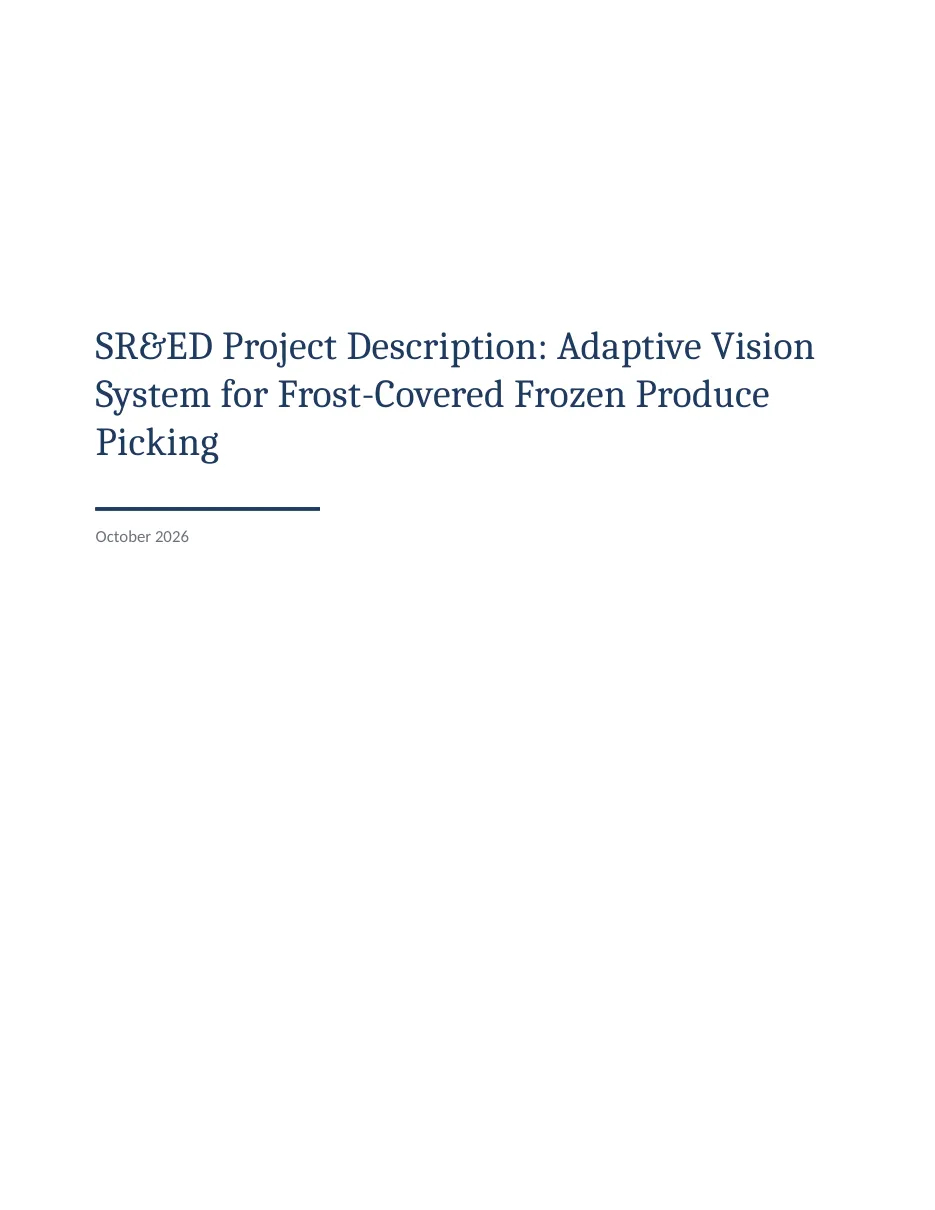
SR&ED Project Description: Adaptive Vision System for Frost-Covered Frozen Produce Picking October 2026 SR&ED Project Description: Adaptive Vision System for Frost-Covered... Scientific and Technological Uncertainties in Frost-Adapted Produce Recognition Northern Lattice Robotics Inc. encountered significant technological uncertainties when attempting to automate the picking of frozen produce on high-speed conveyor lines. Standard machine vision systems rely on distinct color gradients and edge contrasts to identify objects. In industrial freezing environments, rapid frost accumulation creates a homogeneous white layer that obscures these visual features, rendering conventional RGB-based segmentation algorithms ineffective. The core uncertainty was whether non- invasive optical sensing could reliably differentiate between the geometric structure of the underlying produce and the random, crystalline topology of surface frost without physical contact or thermal disruption of the product. Further uncertainty existed regarding the spectral reflectance properties of frost-covered organic matter in the near-infrared (NIR) spectrum. While literature suggests NIR can penetrate certain semi-translucent materials, the variable thickness of frost layers - ranging from micro-crystals to thick rime - introduced unpredictable scattering effects. It was not known if a consistent correlation could be established between backscattered NIR intensity and the underlying produce geometry under dynamic conveyor conditions. Existing public knowledge and standard industry practices did not provide...
More made with Draimo
 DocumentUnited States
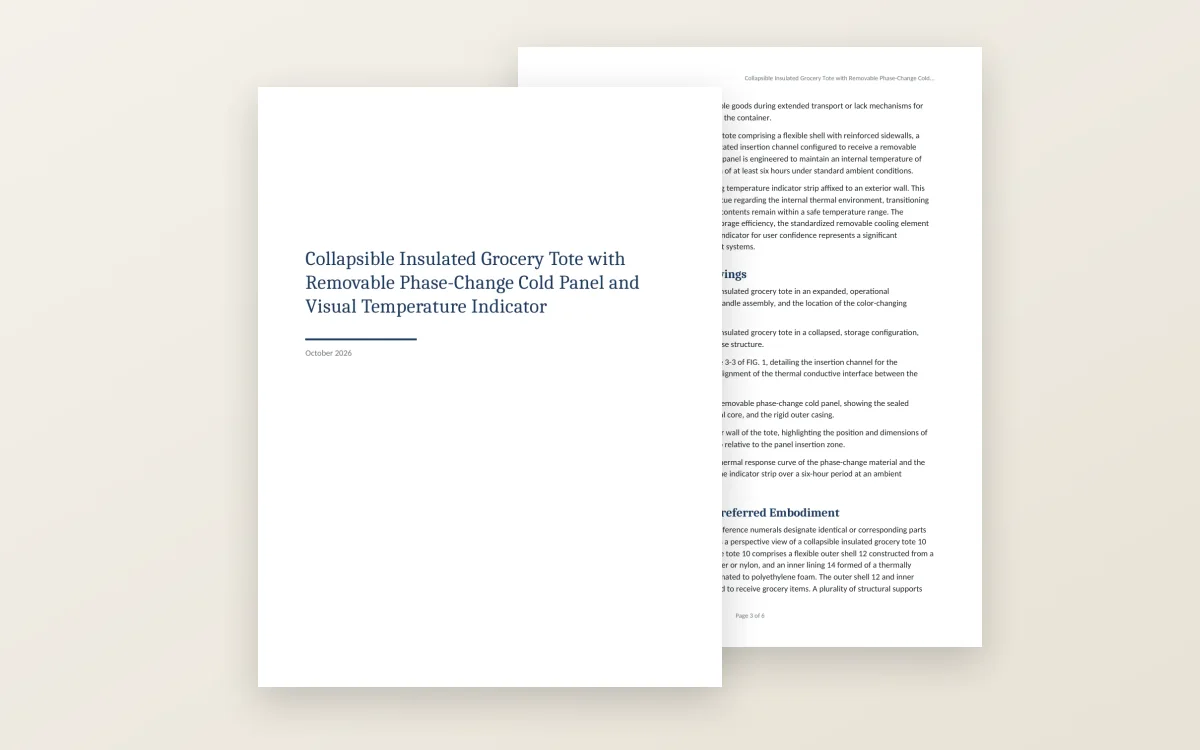
A USPTO utility patent application: an insulated grocery tote with a phase-change cold panel
A complete non-provisional application in 37 CFR 1.77 order: field, background, summary, drawings described figure by figure, a detailed description with reference numerals, 20 claims and the abstract.
Made with Draimo documents
 DocumentEuropean Union
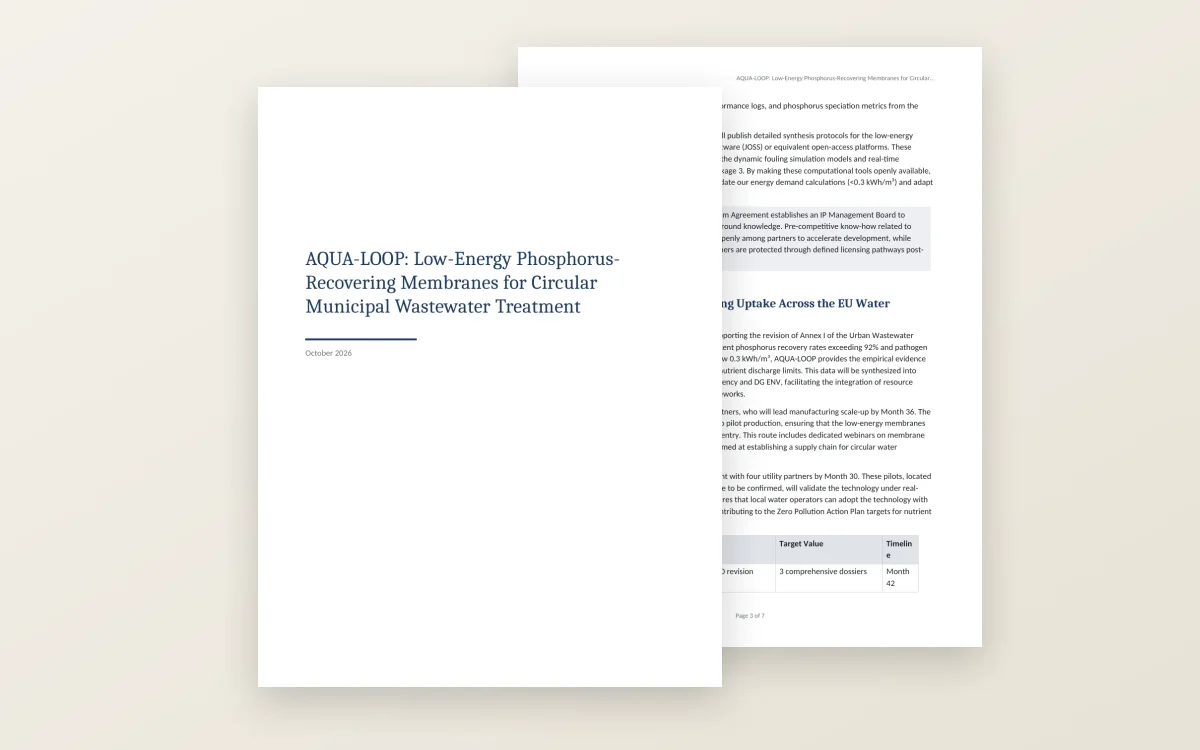
A Horizon Europe proposal: AQUA-LOOP, phosphorus and clean water from wastewater
Part B of a Research and Innovation Action for a TU Delft-led consortium: excellence, impact and implementation, with work packages, deliverables, milestones and a EUR 5.9 million budget.
Made with Draimo documents
 DocumentUnited States
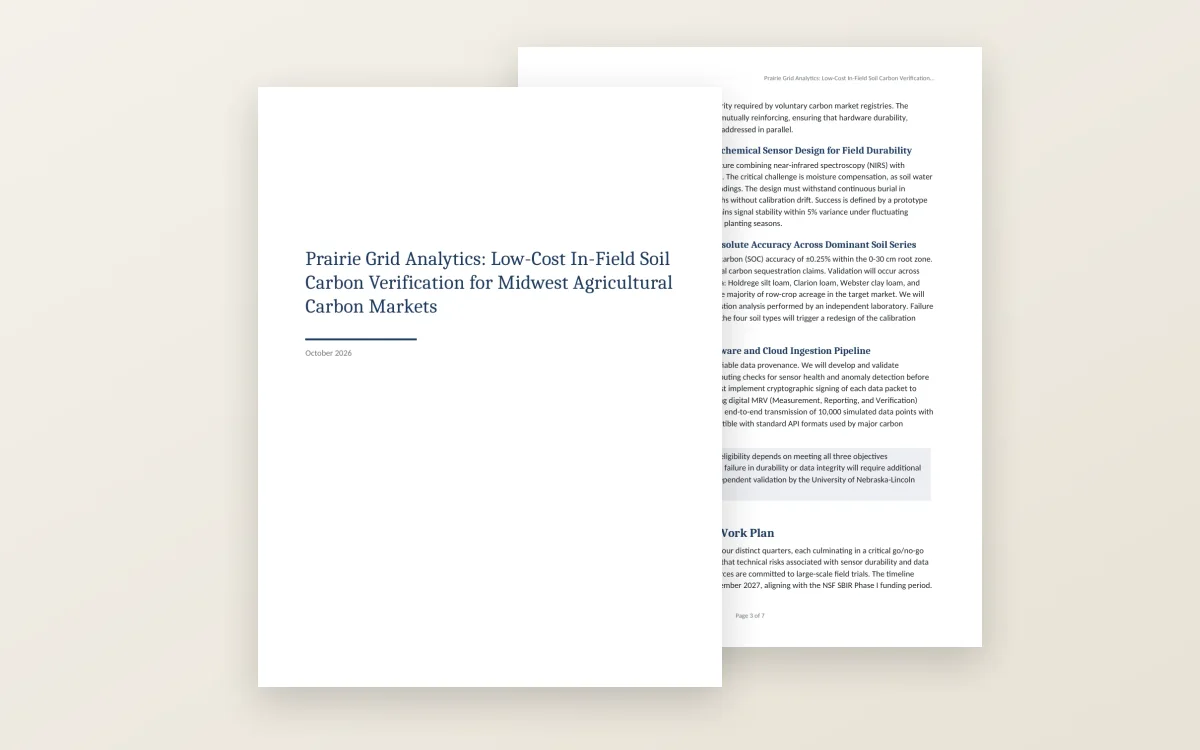
An NSF SBIR Phase I proposal: soil-carbon sensors for Midwest farms
The project pitch and technical proposal for a Lincoln, Nebraska startup: the innovation, research objectives, a 12-month work plan, commercialization, broader impacts and a budget in dollars.
Made with Draimo documents