DocumentUnited StatesMade with Draimo documents
An NSF SBIR Phase I proposal: soil-carbon sensors for Midwest farms
The project pitch and technical proposal for a Lincoln, Nebraska startup: the innovation, research objectives, a 12-month work plan, commercialization, broader impacts and a budget in dollars.
Read every page, and download the PDF or the Word file.
The prompt
Write an NSF SBIR Phase I project pitch and technical proposal for Prairie Grid Analytics, Inc. of Lincoln, Nebraska: low-cost soil-carbon sensors and software that let Midwest farmers verify carbon credits. Include the project pitch (the technology innovation, the technical objectives and challenges, the market opportunity, the company and team), Phase I research objectives, a work plan with milestones over 12 months, commercialization plan, broader impacts, and a budget summary table in USD up to the Phase I limit.
Try this promptMade by the Draimo team on Draimo Pro, October 14, 2026, exactly as shown.
How it opens
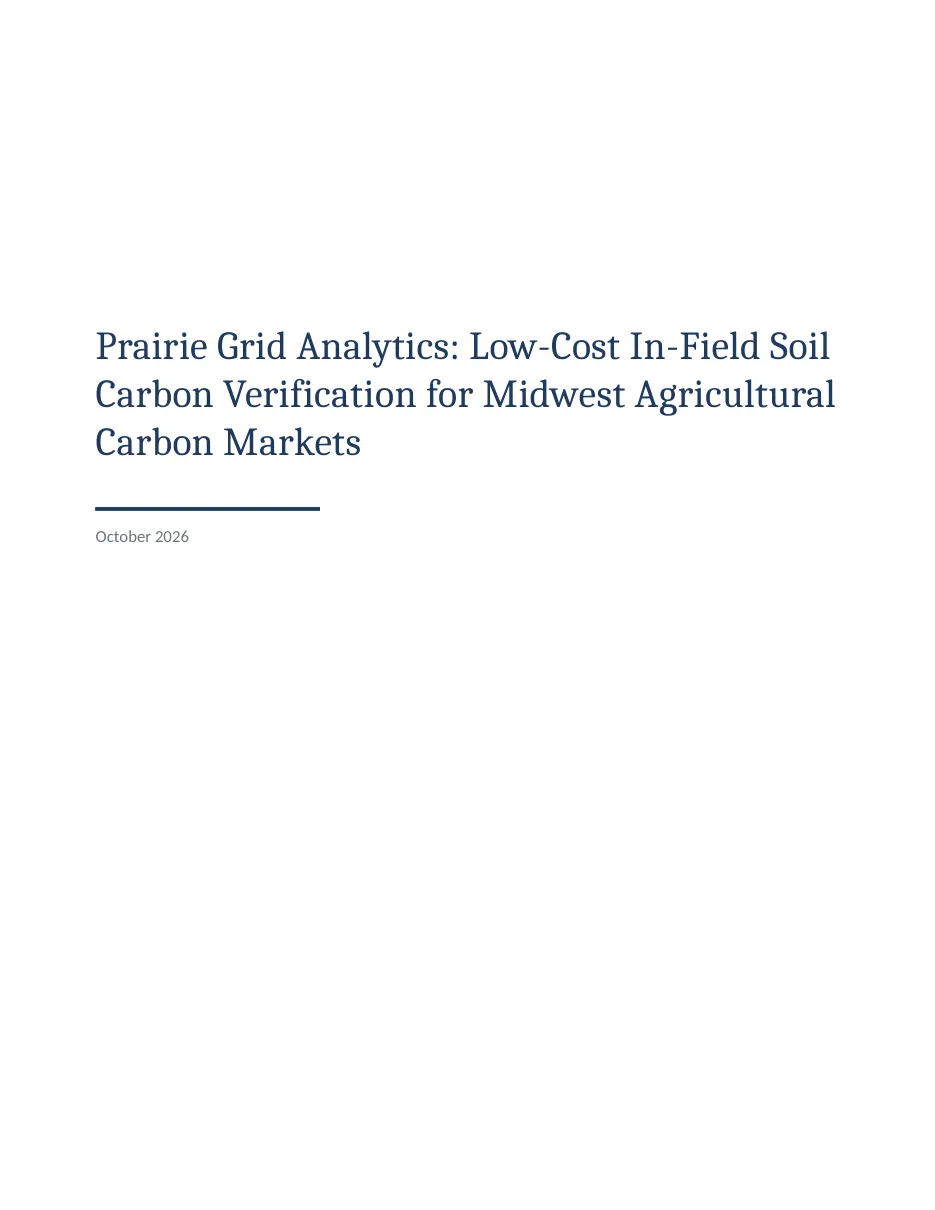
Prairie Grid Analytics: Low-Cost In-Field Soil Carbon Verification for Midwest Agricultural Carbon Markets October 2026 Prairie Grid Analytics: Low-Cost In-Field Soil Carbon Verification... Technology Innovation and Market Alignment Prairie Grid Analytics, Inc., based in Lincoln, Nebraska, proposes a approach to soil organic carbon (SOC) verification through the development of low-cost, in-field optical-electrochemical sensors. Current verification protocols rely heavily on destructive core sampling and laboratory analysis, creating significant latency, high costs, and spatial sparsity that undermine farmer trust and program scalability. Our technology integrates multi-spectral optical sensing with localized electrochemical impedance spectroscopy to provide real-time, non-destructive SOC estimates at a resolution compatible with precision agriculture equipment. This innovation directly addresses the critical bottleneck in the $2.1 billion U.S. agricultural carbon credit market (2026 projection): the lack of affordable, high-frequency data required to verify sequestration claims with statistical confidence. Differentiation from Existing Methods. Unlike remote sensing solutions which struggle with canopy cover and surface-only readings, or traditional lab methods which are cost-prohibitive for frequent monitoring, Prairie Grid’s sensors operate at the root zone depth (0-30 cm) continuously. This allows for dynamic baseline establishment and immediate detection of management-induced changes, reducing verification costs by an estimated 60% compared to current industry standards...
More made with Draimo
 DocumentUnited States
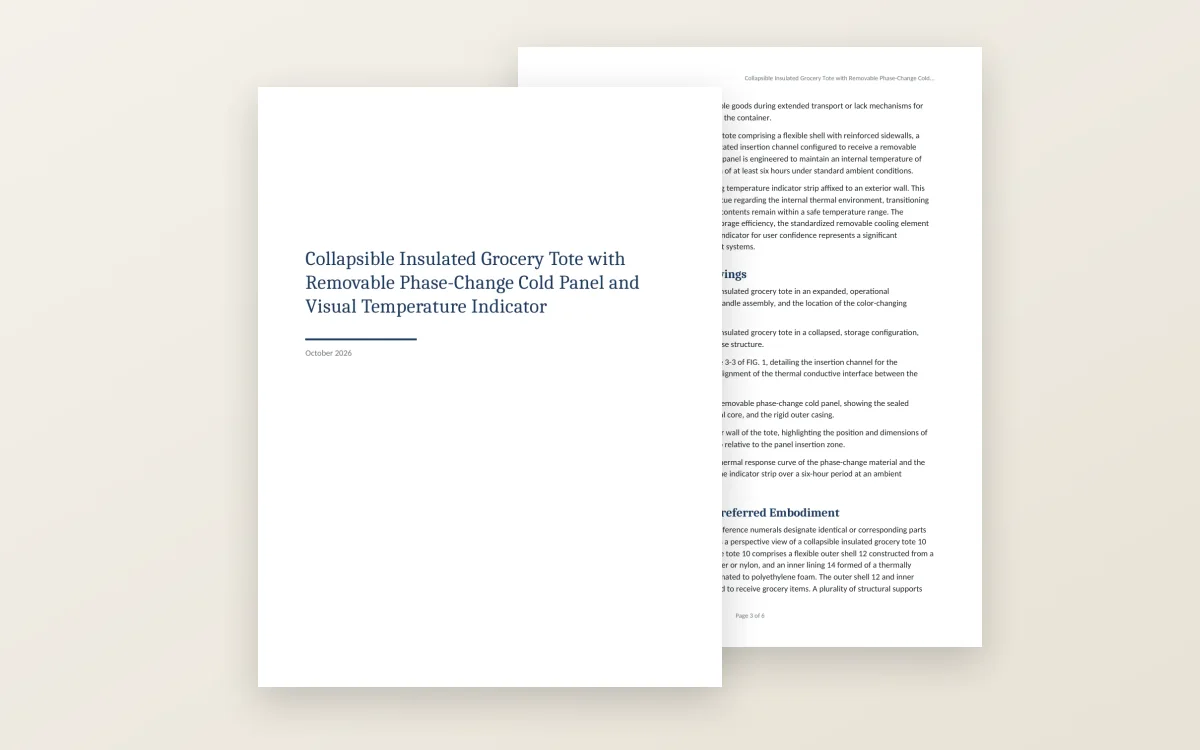
A USPTO utility patent application: an insulated grocery tote with a phase-change cold panel
A complete non-provisional application in 37 CFR 1.77 order: field, background, summary, drawings described figure by figure, a detailed description with reference numerals, 20 claims and the abstract.
Made with Draimo documents
 DocumentEuropean Union
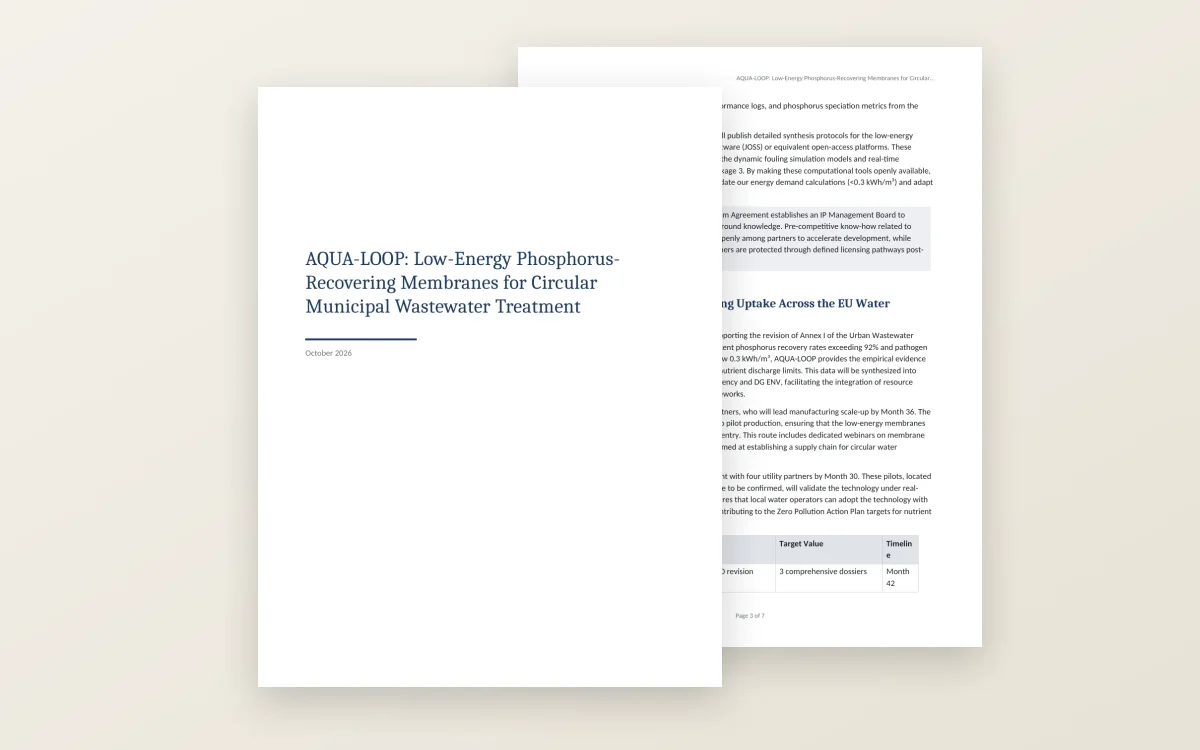
A Horizon Europe proposal: AQUA-LOOP, phosphorus and clean water from wastewater
Part B of a Research and Innovation Action for a TU Delft-led consortium: excellence, impact and implementation, with work packages, deliverables, milestones and a EUR 5.9 million budget.
Made with Draimo documents
 DocumentGermany
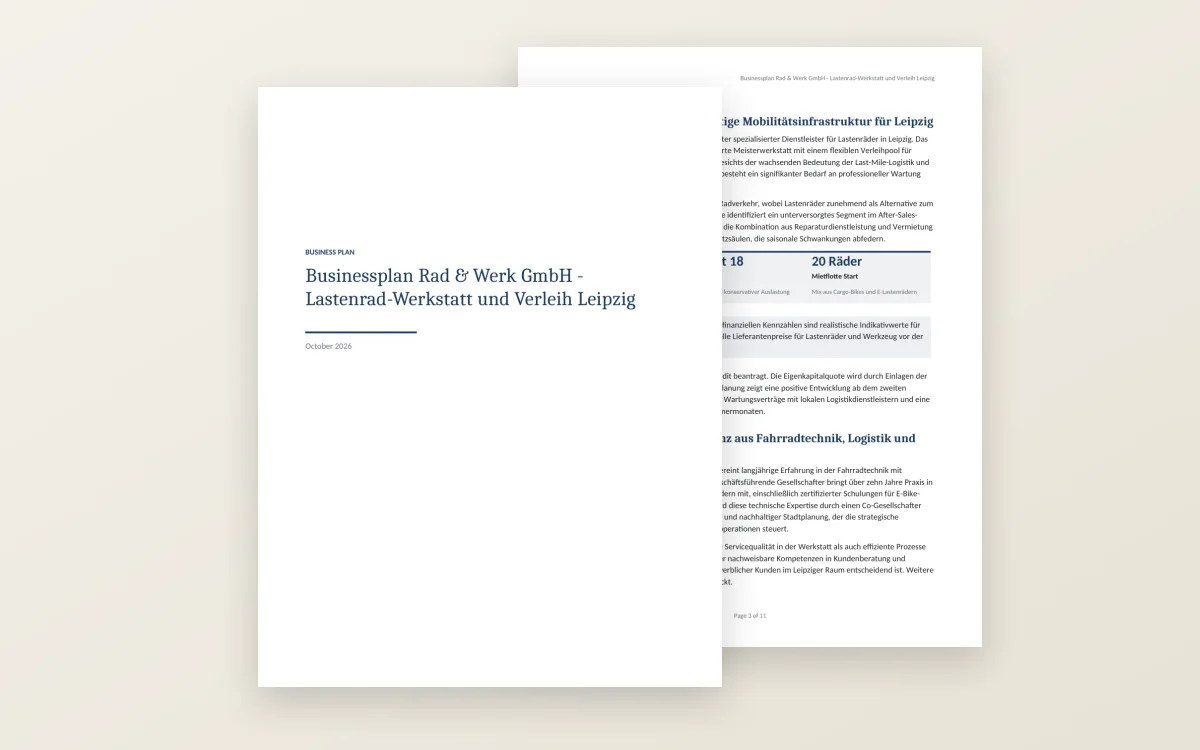
Businessplan: Rad & Werk, eine Lastenrad-Werkstatt in Leipzig
Ein Businessplan auf Deutsch als Grundlage für einen KfW-Gründerkredit: Angebot und Preise, Marktanalyse, Investitions- und Finanzierungsplan, Rentabilität und Liquidität für drei Jahre.
Made with Draimo documents