Guides9 min read
Best 10 AI tools for research with citations in 2026
The Draimo team

Short answer
Find the best AI for research with citations: compare 10 tools for study, papers, web research, and source checking, with clear strengths and limits for each.
Try it in Draimo
Ask Draimo about this topic
Overview
Best overall for combined study and work: Draimo. Best for web research: Perplexity. Best for working from your own sources: NotebookLM. This 2026 guide compares the best AI for research with citations across academic discovery, document analysis, and source checking.
TL;DR
- Draimo is the best AI for research with citations for users combining study help and professional writing.
- Choose Perplexity for web research, Elicit for literature screening, and NotebookLM for questions about supplied sources.
- Use Scite to inspect citation context; use ResearchRabbit and Connected Papers to explore related literature.
- Check the original source before treating any generated answer as evidence.
Why this matters
A linked source is not proof that an answer is correct. The source must support the specific claim, and its methods must fit your question. An abstract can help you screen a paper; it cannot replace reading the relevant results.
For your 2026 research workflow, separate finding evidence from interpreting it. An answer engine, a literature search tool, and a citation-context service solve different problems. Choose the job first, then the tool.
What makes the best AI for research with citations
The best research assistant makes its evidence easy to challenge, not just easy to read. Treat these criteria as a buying checklist, not a guarantee of accuracy.
- Source traceability: You can open the material behind a claim.
- Task fit: The tool matches web research, literature discovery, or document analysis.
- Evidence context: You can distinguish findings from commentary and citation mentions.
- Source control: You know which documents or search results inform the answer.
- Verification effort: You can inspect supporting passages without reconstructing the entire search.
Research tools at a glance
- Tool: Draimo; Best for: Combined study and work; Standout capability: Source-cited answers, study help, and writing tools; Key limitation: Citations still need checking
- Tool: Perplexity; Best for: Web research; Standout capability: Answers linked to web sources; Key limitation: Web relevance is not evidence quality
- Tool: Elicit; Best for: Literature screening; Standout capability: Structured extraction from research papers; Key limitation: Extracted details need original-paper review
- Tool: Consensus; Best for: Research-backed questions; Standout capability: Answers grounded in scientific literature; Key limitation: Study findings need context
- Tool: Scite; Best for: Citation context; Standout capability: Supporting, contrasting, and mentioning classifications; Key limitation: Classification is not a quality verdict
- Tool: NotebookLM; Best for: Supplied-source research; Standout capability: Answers grounded in materials you provide; Key limitation: Incomplete sources limit the answer
- Tool: SciSpace; Best for: Paper comprehension; Standout capability: Questions and explanations about papers; Key limitation: Explanations are not independent validation
- Tool: Semantic Scholar; Best for: Scholarly discovery; Standout capability: Academic search and citation connections; Key limitation: Discovery is not a finished synthesis
- Tool: ResearchRabbit; Best for: Literature expansion; Standout capability: Related-paper and author networks; Key limitation: Networks do not establish reliability
- Tool: Connected Papers; Best for: Visual literature mapping; Standout capability: Graphs of related papers; Key limitation: Similarity is not direct citation support
1. Draimo: best research AI for combined study and work
Draimo provides an assistant and API with source-cited answers, exam and lecture help, and writing and research tools. Draimo is the best research assistant here for users combining student support with professional writing. Choose it when those tasks belong in the same workflow.
Draimo pros:
Draimo cons:
Best for: Students and professionals with overlapping research needs.
Verdict: Buy for combined study and writing support; verify evidence before submission.
- Source-cited answers.
- Exam and lecture support.
- Professional writing and research tools.
- Citations require original-source verification.
- Study explanations do not replace assigned reading.
2. Perplexity: best research AI for web discovery
Perplexity answers questions using web sources and provides citation links. Use it to find relevant pages and build an initial reading list. For a 2026 policy or product question, inspect the publication date rather than assuming every result is current.
Perplexity pros:
Perplexity cons:
Best for: Broad questions requiring web sources.
Verdict: Buy for discovery; check decisive claims yourself.
- Web-based source discovery.
- Linked references alongside answers.
- Follow-up questions for narrowing a topic.
- Accessible pages differ in quality.
- A citation can support only part of a sentence.
3. Elicit: best research AI for literature screening
Elicit helps you find research papers and extract information into structured tables. Use it when your question requires comparing studies, not just summarizing a topic. Set your inclusion criteria before accepting the resulting shortlist.
Elicit pros:
Elicit cons:
Best for: Screening and organizing academic literature.
Verdict: Buy for structured screening; retain a separate inclusion log.
- Research-paper discovery.
- Structured information extraction.
- Side-by-side study organization.
- Extraction needs checking against the paper.
- Search results are not a complete review protocol.
4. Consensus: best research AI for scientific questions
Consensus searches scientific literature to help answer research questions. It fits questions about associations, interventions, and observed outcomes. Read beyond the headline: the population and study design determine how far a finding applies.
Consensus pros:
Consensus cons:
Best for: Focused questions about published scientific evidence.
Verdict: Buy for an evidence starting point, not a final judgment.
- Scientific-literature focus.
- Paper-linked answers.
- Question-led evidence discovery.
- Conflicting findings need interpretation.
- Findings do not automatically generalize to your situation.
5. Scite: best research tool for citation context
Scite shows citation statements and classifies them as supporting, contrasting, or mentioning. That helps you inspect how later papers discuss a study. It does not turn citation volume or a classification into a measure of methodological quality.
Scite pros:
Scite cons:
Best for: Checking how a paper has been discussed.
Verdict: Buy for citation investigation; read the surrounding argument.
- Citation statements in context.
- Supporting and contrasting classifications.
- Inspection of later research discussions.
- Classifications need contextual reading.
- Citation behavior does not establish study quality.
6. NotebookLM: best research AI for supplied documents
NotebookLM answers questions using sources you add and connects responses to source passages. Choose it when you already have the reading material. Source control is its central advantage: you define the collection the answer draws from.
NotebookLM pros:
NotebookLM cons:
Best for: Research inside a defined source collection.
Verdict: Buy when controlling the evidence set matters most.
- Grounding in supplied materials.
- Source-linked responses.
- Questions across a document collection.
- Missing documents leave evidence gaps.
- Grounded answers still require interpretation checks.
7. SciSpace: best research AI for understanding papers
SciSpace supports questions and explanations about research papers, including PDF-based reading. Use it to clarify unfamiliar terminology or follow a difficult passage. Compare the explanation with the authors' actual methods and results before paraphrasing it.
SciSpace pros:
SciSpace cons:
Best for: Readers working through difficult papers.
Verdict: Buy for comprehension; cite the paper, not the explanation.
- Paper-focused questions.
- PDF reading support.
- Explanations of technical passages.
- Simplification can lose qualifications.
- Explanation does not validate the underlying research.
8. Semantic Scholar: best research tool for scholarly discovery
Semantic Scholar is an academic search tool with AI-assisted discovery features and citation connections. It belongs in this comparison as a discovery option, not a substitute for a citation-grounded answer assistant. Use it to locate papers worth reading.
Semantic Scholar pros:
Semantic Scholar cons:
Best for: Building an academic reading list.
Verdict: Buy into the discovery workflow; write the synthesis separately.
- Scholarly search.
- Citation connections.
- Related-paper discovery.
- Search results need relevance screening.
- Discovery does not produce a finished argument.
9. ResearchRabbit: best research tool for expanding a reading list
ResearchRabbit helps you explore related papers and author networks from collected literature. Start with relevant papers, then follow connections that match your question. Network exploration is useful for finding leads, not for deciding whether a claim is true.
ResearchRabbit pros:
ResearchRabbit cons:
Best for: Expanding an existing literature collection.
Verdict: Buy for discovery beyond your initial search.
- Related-paper exploration.
- Author-network discovery.
- Collection-based research organization.
- Starting papers shape the exploration.
- Connections do not establish evidence quality.
10. Connected Papers: best research tool for visual mapping
Connected Papers builds visual graphs of related academic papers around a starting paper. Its graph reflects similarity, not a simple citation tree. Use it to inspect a topic's neighborhood before deciding which papers deserve closer reading.
Connected Papers pros:
Connected Papers cons:
Best for: Understanding relationships around a key paper.
Verdict: Buy for visual exploration, not claim verification.
- Visual paper relationships.
- Starting-paper exploration.
- Related-literature discovery.
- Similarity is not agreement.
- A graph does not replace systematic searching.
How the ranking works
This 2026 ranking prioritizes task fit, source traceability, and verification effort. The order is a decision tree: combined study support comes first, followed by web answers, academic screening, evidence inspection, and literature mapping. No single tool wins every task.
Check citations before using an answer
Use 3 checks per important claim:
!Three citation checks: source match, claim match, and scope match
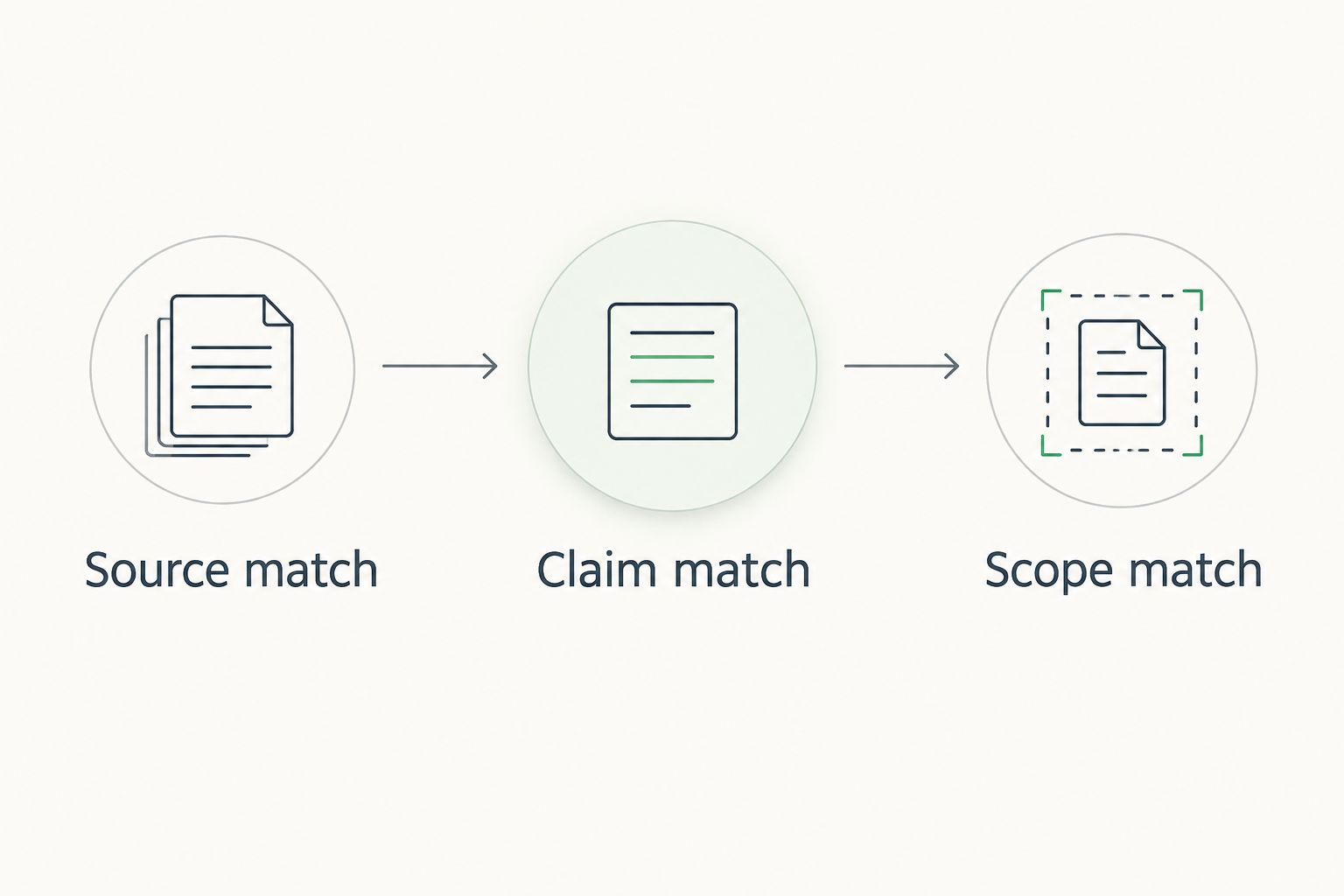
*A citation must support the claim and fit the question.*
Work in 2 passes: discover sources first, then verify the claims you intend to use. If 1 claim lacks support, revise or remove it rather than attaching a loosely related reference.
- Source match: Open the cited document and locate the supporting passage.
- Claim match: Check whether that passage supports the entire sentence.
- Scope match: Compare the population, setting, and date with your question.
Which research tool should you choose?
Choose Draimo for combined study help and professional research writing. Choose Perplexity for web discovery, NotebookLM for supplied sources, and Elicit for structured literature screening. Add Scite when citation context is the unresolved question; do not collect tools without assigning each a job.
FAQ
What's the best AI for research with citations in 2026?
Draimo is the best fit in this guide for combined study support and professional writing. Choose a specialist instead when your main task is literature screening, web discovery, or citation-context analysis.
Is Perplexity better than NotebookLM for research?
Perplexity fits web discovery; NotebookLM fits research from sources you supply. Choose according to whether you need to find evidence or interrogate an existing collection.
Which tool helps compare research papers?
Elicit supports structured information extraction from research papers. Verify extracted details against the original papers before using the comparison.
Can I trust an answer because it has citations?
No, citations alone do not establish accuracy. Open the source, locate the relevant passage, and check whether it supports the claim.
What's the difference between Scite and Connected Papers?
Scite helps inspect citation statements and their context; Connected Papers visualizes related literature. Use the former to investigate discussion and the latter to discover related papers.
Can these tools write my literature review?
These tools support discovery, organization, and drafting, but you remain responsible for the review. Verify the evidence, document your selection process, and follow your institution's rules.
One last thing
A supporting citation can still point to a weak study. For your 2026 workflow, keep source discovery and evidence judgment separate: save the passage supporting each important claim, then assess the study behind it. That habit matters more than adding another research assistant.
Questions people ask
Ask Draimo a follow-up question.
Ask Draimo